Showing posts with label 1938. Show all posts

Saturday, December 3, 2011

[1938] Horses

Many tacticians believed that the horse's role as a military vehicle was done by the end of World War I. At the start of the conflict in 1936, mounted cavalry was quickly re-implemented by all sides because, despite wanting armor and trucks, the horse was actually more readily available in parts of Britain.

While the Household Cavalry, consisting of the Blues and Royals and the Life Guards, already have horses, and excellent horseflesh at that, many of the other units range from old plugs to the cream of upper-class stables, with the majority being draft horses or country-bred nags.
Horse thievery, as expected, is now an acceptable (and common) method of warfare.

Tuesday, August 23, 2011

[1938] The Penal Gang

There is one criminal platoon in the 1st Solway BUF. C Company, 2nd Platoon, Lt. Alfred Jingle commanding. These chaps were all in jail for a variety of reasons and when the whole thing went up in 1936, the jailer (a BUF man) gave them the choice: serve the BUF (and the King, by extension) or serve your time. A number of the younger lads did just that. And they've been nothing but trouble for Lt. Jingle and C Company's commander Captain Edward Leeford ever since.

The trouble with penal military units is that they're trouble. Discipline? Honor? Duty? Not much of any of those. As a result, in each engagement, they've retreated rather than hold, destroyed (and stole) useful gear (but left little evidence of the thefts) and made a general nuisance of themselves. And they're at the end of their tether and not getting any better.

They've been moved around so much during the siege that they've got no trust from their fellow soldiers (not that they've done anything to earn that trust, quite the opposite). They've been banned from the town and the problems that they are causing are increasing the resistance within the townsfolk towards the whole 1st Solway.

The criminals of 2nd Platoon fear no-one, except for The Butcher. Oh, yes. Him they fear. And Thompson disappeared last week, after mouthing off to The Butcher. There's speculation that he's somewhere in a ditch, with a bullet in the back of his head.

With Jingle and Leeford at wits end, Thornsby is hoping that the Manx forces will whittle down 2nd Platoon for him, but he has no plans for dealing with them so far. As a group of wild cards in the deck, the GM can used them as troublemakers on both sides, shooting at the wrong time, going farther afield than ordered (both in terrestrial distance as well as authority) and generally making themselves trouble for the PCs.

Monday, August 8, 2011

[1938] Molotov Cocktail

A Molotov Cocktail is a fuel bomb, cheap to make and easy to use. Simply fill a bottle with petrol and tie a petrol-soaked rag around the neck. A quick light and throw, and you've set something on fire.

In terms of Savage Worlds, it's as follows:

Molotov Cocktail
Range: 5/10/20 (small burst template); Damage: 2d10; Notes: roll d6 (5-6 catches subject on fire).

Wednesday, July 20, 2011

[1938] Body Armor

Body armor in 1938: A Very British Civil War is pretty limited. The most the majority of armed forces can field are helmets but a few groups have access to more than that.

Most body armor in use was scrounged from formal military dress (like the Household Cavalry) or from museums (like the Imperial War Museum) or other collections, including German pieces that returned to England after WWI.

The most common that is fielded is a cuirass (breast only) or a corselet (breast and back). Neither are bullet-proof but they may offer some protection against grenade fragments. Most users believe that something is better than nothing.

Savage Worlds stats
Helmet: Armor +4 (50% chance v. head shot), Wt. 5#
Cuirass  (breast only): Armor +3 (from front), Wt. 15#
Corselet (breast and back): Armor +3, Wt. 25#

Sunday, June 26, 2011

[1938] Locations: The Howe

The Howe is the main southern base of the Manx forces, comprised of the bulk of the Ramsey Company (Captain Arthur Gride, commanding) and the Liverpool Free Staters (Lt. Colonel Arthur Havisham, commanding).

The Howe is directly west of Port St. Mary, along the Howe Road, past the intersection of the Glen Chass Road. There are a half-dozen houses and shops, including The Howe Public House, along the Howe Road. Most of the outbuildings are occupied by soldiers and the Pub is the command HQ (but is open most days to the locals). Trenches surround the hamlet as a raid early in the fighting brought the idea home that a seige doesn't always work the way you'd think.

The Manx forces regularly patrol the Glen Chass Road, down to the Fistard Road, where another Manx company is dug in. After that first raid, not much is happening along this front but that doesn't mean that the troops are lax - the opposite in fact. Gride and Havisham work well together, maintaining distinct commands while drilling their troops to support each other. Gride is more cautious while Havisham is more daring. Between the two of them, the region they control is totally theirs.

The Howe is a good place for PCs to interact with fellow Manx forces, in a bucolic setting without bullets flying. Additionally, there is some espionage work here, as several of the resistance groups in Port St. Mary send info to the Howe.

Sunday, June 19, 2011

[1938] Up Armored Truck

With the start of the Very British Civil War, armor, and especially light armored cars, were in short supply. Many militaries, however, have solved the problem in the short-term by armoring lorries with as thick a plate as they can find.

Here's an example of one 2 ton truck, in Savage World terms:

Up Armored 2.0 Tonne Truck:
Acc/Top Speed: 5/40Toughness: 13/8(4/2)
Crew: 2 (driver, gunner) +10 passengers
Notes: Four-Wheel Drive, Soft-sided; Toughness 8 for the undercarriage.
Armament:
.30 Cal Machine Gun (Range: 30/60/120, Damage: 2d8+1, ROF 3, AP 2)

Saturday, June 11, 2011

[1938] Locations: the Four Roads

The Four Roads is located just outside of Port St. Mary, at the intersection of Plantation Road and Beach Road, and Station Road and Bay View Road. The Four Roads intersection is currently controlled by Platoon 3, Company B, of the BUF Solway Legion.

Commanded by Lt. Mulberry Hawk, the BUF soldiers support the rest of Company B located at the Port St Mary Railway Station, keeping the road open to the village. The BUF have dug full trenches along the roads and into the fields around. There are no nearby buildings, so the habitations are crude and rough, and the men are miserable most of the time. Couple that with the road being used (and most of the trenches below the raised roadways) makes the trenches hazardous as well as uncomfortable - two lorries took a dive into a trench last week during the rains, killing several soldiers. Resentment is starting to grow among the lower ranks.

On both sides of the Four Roads, the Manx forces are arrayed. To the west along Truggan Road, Lt. William Guppy commands the 1st Union Mills Platoon, 1st Douglas Company. To the east, along the Beach Road, Lt. Richard Payne commands the Castledown Militia, Castledown Company. These platoons have better accommodations, including actual buildings, but they have set up a half-dozen trenches in their area. Morale is rather high for both as well.

The fighting here is not as intense as at some other places, but shots do ring out on a regular basis.A push to cut off the Port St. Mary Railroad Station is in the works, and tunnels to the intersection have been underway for some time.

Tonight, we're making the push - can you take that trench over there while the Castledown Militia makes a feint? Good chaps!

Sunday, June 5, 2011

[1938] Mort's Blog

The Battle of Henton
When I joined the Edward VIII Cocktail Bar forum over on the Gentlemans Wargames Parlour, Mort was one of the first fellows to welcome me to the fold of 1938: A Very British Civil War.

Mort's 1938 Scrapbook blog is excellent, providing great pictures of miniatures, a look into his 1938 notes  and the war games he gets into over in England.

It's so good, I included it in my blog roll. Check it out!

Tuesday, May 24, 2011

[1938] Flame Fougasse

A Flame Fougasse is an anti-tank explosive mine that covers the target with flaming liquid. The advantage of this style of weapon was it was cheaply assembled as a trap to attack vehicles and men, as all that's needed is a barrel filled with a gas/oil mixture, some explosives and a hill or road bank (safety fougasse) or a spot on the side of the road (demigasse).

This weapon was developed in early 1938 by Royalist forces when it was used to great effect on the outskirts of Liverpool during a failed LFS push. Soon the secret of it leaked out and now all sides are using it in the Civil War.

Flame Fougasse (Savage Worlds)
Range: 25 (in large cone template)
Damage: 2d10 on the turn it explodes, the burning liquid sticks to the victim or vehicle, causing a fire check of 4-6 on a d6 with a successful Agility check to take half damage.
Note: A critical failure on setting up the weapon will cause a premature explosion.

Wednesday, May 18, 2011

[1938] Submarine U-152

In November 1918, the German submarine U-152 surrendered at Harwich, England. But I start the story at the end of WWI, not earlier.

U-152 , a Type U-151 submarine, was built to be a mobile quartermaster for other subs, but was changed to a combat sub mid construction. She was commissioned a year before she surrendered, in October, and then started her cruise by sinking American schooner Julia Frances in January 1918, and another, the Whyland, in March 1918. In September, she fought two US Navy ships, oiler USS George G. Henry (who managed to escape, heavily damaged) and cargo ship USS Ticonderoga (which was sunk). Her last prize was the Norwegian barque Stifinder. The submariners boarded the ship and scuttled her in October.

After that, nothing more until 1921, when she sank on her way to the scrapyard.

But what if that hadn't happened? What if Naval Intelligence kept the little sub that could and operated it all the way up to 1938? What if this little sub is the first modern black project?

No worries, I'm not going to stat this out in Savage Worlds. Best to leave it as a transport or a scene where adventure takes place. But which side is she on? What would the Liverpool Free State do with her? Or the Isle of Man, for that matter. Her fate could be up to the PCs, either by being crew or taking her in a surprise attack. Either way, it'll be exciting!

Tuesday, May 10, 2011

[1938] Mutiny in the Royal Navy

The history of the Royal Navy in the 1930s was fraught with drama. For two days in September 1931, Royal Naval ships were in full mutiny at Invergordon, Scotland. It was over pay and, while polite (mostly) to the officers, several ships worth of men refused to follow orders.

This occurred a full 5 years before the state we find ourselves in and my belief that the situation wouldn't have changed much in less than a decade. With the appointment of Mosley and the fracture of the Empire, the Royal Navy, for the most part, went anti-Fascist, most actually Red. The majority of ships mutinied and Royalist officers were seized and put in the brig.

There were few engagements between the pro- and anti-Royalist navies until mid-1938. The HMS Dorsetshire and the HMS Cornwall supported the Liverpool Free State and the Isle of Man. Mosley ordered the nearest loyal naval vessel, the HMS Hood, as well as the Royal Air Force to break that support. Ironically, on May 1st, Fascist and Royalist forces attacked both ships, with the Hood starting a bombardment and the RAF attacking from above. By the end of the fighting, the Dorsetshire and the Cornwall were still afloat (the Cornwall took extensive damage) but the Hood was sunk, with a loss of over 1000 men.

Before this time, rival ships had been simply content to "pass in the night." With the direct attack by a Royalist ship, the shooting war between the different naval forces began in earnest. Newspapers on both sides of the conflict used the sinking of the Hood and the loss of life to paint the other side as the aggressors and their side was true. The true news, however, was that the Royal Navy, a military tradition since the 16th century, had reached its nadir.

Friday, May 6, 2011

[1938] Sticky Bomb

The Sticky Bomb was a World War II British anti-tank weapon made from nitro and adhesive, and with a 5-second fuse. The official name was the Anti-Tank No. 74 Hand Grenade.

First issued in 1940 to Home Guard troops, the weapon was also used by regular army. Considered by some to be a stop-gap at a time when Britain lacked effective anti-tank weapons, it took a personal order by Churchill for 3 million of the bombs to be made.

Despite it's flaws (adhering to dusty, dirty or muddy vehicles was a problem), it was effective. In fact, in 1943, six German tanks were taken out in a little town called Thala in North Africa by these sticky bombs.

In 1938: A Very British Civil War, the sticky bomb is used by all sides of the conflict (or at least those who have the materials to do so) in an attempt to disable and destroy the various forms of mobile armor that have been scrounged, built, requisitioned or bought.

In terms of Savage Worlds, the Sticky Bomb is as follows:

Range: 1/2/4, Damage: 3d8, Notes: AP 3 (5 if well-secured to hull).

Wednesday, May 4, 2011

[1938] Dirigible! R100 and R101 on the loose

Continuing with the air-power for my 1938: A Very British Civil War Isle of Man campaign, I present the rival dirigibles, R100 and R101.

During late WWI and the interwar period, several rigid dirigibles, the R series, were developed for the British military. The R series included:
  • R23X class (serial R27 and R29, first flights 1918),
  • R31 class (serial R31, first flight 1918, and R32, first flight 1919),
  • R33 class (serial R33 and R34, first flights 1919),
  • R36 class (serial R36, first flight 1921, and the never built R37),
  • R38 class (serial R38, first flight 1921, with R39, R40 and R41 never built),
  • R80 class (serial R80, first flight 1920), and
  • R100 class (serial R100 and R101, first flights 1929)
When R38 crashed during her first flight in 1921 near the city of Hull, the military project was closed. Despite a re-vamp in 1925, with R33 (and a whole adventure story about that), things then petered off until 1929, when R100 and R101 were developed and flown. Two separate groups developed these ships - a private company Vickers built the "Capitalist Airship" R100, while the Government Air Ministry built the "the Socialist Airship" R101. Both flew in 1929, with the R101 crashing in late 1930, killing 48 of the 55 passengers and crew. This final event ended the British dirigible program.

But what could be in an alternate timeline? Perhaps both R100 and R101, the "Capitalist" and "Socialist" airships survived to 1938. Perhaps they took sides similar to their nicknames. Perhaps they now spend the bulk of the Very British Civil War playing a cat-and-mouse game in the clouds, fighting their own version of the war. Perhaps, perhaps, perhaps.

So here are the stats for R100 and R101 (using Clint Black's Savage Crimson Skies rules). They're the same, pretty much, but have some different glitches.

And to prevent anything from shortening the adventure (one shot and *boom*), they use helium (in 1935, the British government managed to get a contract from the US for their two flagships), so the very explosive hydrogen hasn't been used for a couple of years. No *boom*.


R100/R101 (3 points)
Crew:
  • R100: 37 + 63 passengers (max capacity 100)
  • R101: 45 (15 minimum) + 55 passengers (max capacity 100)
Speed: 8 (Average, 2 points)
  • R100: maximum speed: 81.5 mph, cruising speed: 50 mph, range: 4095 miles
  • R101: maximum speed: 71 mph, cruising speed: 63 mph, range: 4000 miles
Toughness: 12 (2) (Poor)
Weaponry:
  • 8x Machineguns (Range: 15/30/60, Damage: 2d8, RoF: 3, Notes: AP2) (Poor)
Hard Points: 0 (Poor)


Glitches (1, -1 point):

  • R100 - Engine Overheating- This aircraft’s engine overheats when stressed. When performing any maneuver with a –4 or worse modifier, this vehicle suffers an additional –2 modifier.
  • R101 - Fuel Hog- This aircraft suffers a –2 modifier when rolling for fuel usage.

Upgrades (2, 2 points):
VTOL (dirigible) - stall speed is 0 (see Decreased Stall Speed).

Improved Handling- All Piloting rolls gain a +1 bonus.

Wednesday, March 23, 2011

[Pencast] The Airstrip Map

Pencast no. 5 is a map for The Airstrip in my 1938: A Very British Civil War Isle of Man Campaign. I recorded this pencast when I was waiting for a game to start at a local game shop.

The map shows the general layout of the airstrip, including the hangar, the office and the trenches the BUF soldiers have dug for protection.

I'm going to post more of the 1938 locations maps, so look for them in the coming pencasts.

[1938] Locations: Port St Mary Railway Station

File:Port-st-mary-railway-station.jpg

The Port St Mary Railway Station is currently under control of the BUF invaders. The station, an imposing two-story brick structure, is along Station Road between Port St Mary and the Four Roads crossroads.

Platoons 1 and 2, Company B, of the BUF Solway Legion are in charge of security, with Platoon 1 in the station itself and Platoon 2 supporting the Station Road.

Platoon 1 has a half-dozen sandbag positions around the station and on the platform, connected with trenches to each other. The second story of the station building has three machine gun nests, one each, covering the approaches from the Four Roads to the north, the field towards the Castletown Road to the east, and the rail line to Port Erin to the west (where the Isle of Man Railway terminus is located).

Along the Station Road, Platoon 2 has dug several half-trenches, lined with sandbags, logs and whatever else the soldiers could find. An up-armored truck brings supplies to the platoons every day at the same time.

There is a broken-down steam locomotive, called the Old 97, just outside the station, about 80 yards, pointing towards Port Erin. The train is not battle damaged and seems to be ignored by local Manx forces. Though it is nominally in no-mans land, on most days the BUF has a squad occupying it to prevent being snuck-up on from that direction but they abandon it at night. Sometimes, they start the fire up to keep warm.

The repair on the train wouldn't take too long but they could be noisy. It would take some research to find out what happened to it - from asking around to find the last engineer to drive it (John "Steve" Browdie, currently in Port Erin), to getting the parts together to repair it, and to finding someone (or training them) to drive it. It still has enough water and fuel to start up. Stoking the fire to get enough steam would be about a half-hour, forty-five minutes, or an hour at the most.

So the Manx commanders want the train. It's vital to get it away from the BUF because they may get around to fixing it themselves and use it to invade the rest of the island. You've got a week or so to do the job. And you can expect that the BUF are going to fight to keep it.

Saturday, March 19, 2011

[1938] Locations: The Short Walk and Trench 13

File:Periscope rifle Gallipoli 1915.jpg
As in the Great War, sometimes there are places where enemies are closer than friends, within throwing distance (or sometimes just beyond). And such is the case with a section of the siege around Port St. Mary.

Along one part of the line is a set of trenches that nearly butt upon each other, with the fascists on one side ("Trench 13") and the Manx forces on the other (the "Short Walk"). Each set of trenches has been taken several times since the siege began and each time has been recovered by their nominal owners in later fighting. In fact, the "Short Walk" is the most brutal and most active of the battle sites around the town.

Despite this brutality, or maybe because of it, the forces on both sides (3rd Platoon, A Company, BUF Legion, commanded by Lt. Taylor Trabb, and The Cronk Irregulars, commanded by Lt. Arthur Duff) are fairly friendly with each other, shouting encouragement and well-wishes when not fighting and patching up each other after the fighting is done. There was even an impromptu soccer game at one point early on (sure, it ended in gunfire, but that fellow was past the line and that goal bloody well didn't count).

Both companies have resisted attempts by their own commands to switch them out, insisting that a change would create more problems than they're worth, including not knowing who their fighting and a breakdown of the slightly bent "rules of war" that they're operating under. BUF command, however, is increasing concerned that the friendliness could be detrimental to security and are working to implement a change. This includes a back-up plan to give up the trenches for a better position closer to the village.

A few days ago, an event happened which changed everything. Lt. Trabb was wounded and evac'd back to Port St. Mary. His replacement was newly commissioned Lt. Chancery Gridley. The new officer is not only a martinet and annoying to boot, he's actually messing with how the two groups are fighting this war. They've got their way and he's not part of it.


The area is set to explode. And who walks in? Why the PCs, of course. Cue dramatic music!

Wednesday, March 16, 2011

[Pencast] Map of Port St Mary

Pencast no. 3 is a map of Port St. Mary for my 1938: A Very British Civil War Isle of Man Campaign. I show where the Airstrip, the Carrick Light-House Island and the Standing Stone are located and also mention a few other upcoming blog post locations.

More pencasts to come!

Sunday, March 13, 2011

[1938] Locations: The Standing Stone

File:Ballinagree.jpg
The Standing Stone is an ancient menhir locally called The Giant's Quoiting Stone. It is located just outside the village of Port St Mary, in a large field located between Beach Road on the south and the rail line to the north, northeast of Station Road and southwest of Castletown Road. The field is currently no-man's land, with BUF forces at the corner of Beach and Station Roads and Manx forces along Castletown Road.

According to legend, a Giant lived in the area in ancient times and came there to play Quoit (similar to ring toss) with the local Manx, beating them and using the win to gain in trade and news. The stone has mystical properties and only the pure of heart may touch it. It is also linked to the fair folk in local histories, especially during the Elizabethan era. The locals shun the stone except to leave gifts of food to the fairies, which they do with regularity.

Several BUF soldiers scoffed at the warnings and one ate an apple left as a gift. Later that night, he had excessive cramps, which the villagers took as a sign of fae displeasure and the BUF took as just a bit of rotten fruit (but amazingly, and by unspoken agreement, decided to leave the area alone).

The stone is left to itself by both BUF and Manx forces, with few trenches near it. Still, the locals keep up with the gifts. One or more of the intelligence groups in the village use the stone to pass along messages to each other as well as to the Manx army. 

In fact, it's a new moon tonight. A vital bit of intelligence has been left at the stone for pickup. No worries, there is a good 30 yards between the stone and the nearest BUF trench. You should be able to get the packet without a shot being fired. Chop, chop! You go over the wire in 3 hours!

Friday, March 11, 2011

[1938] Locations: The Carrick Light-house Island

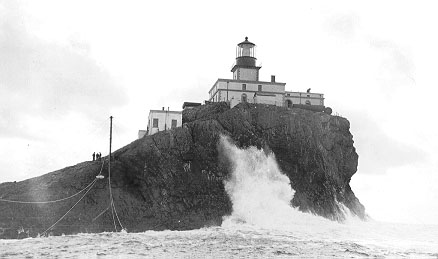
In Bay ny Carrickey, right out of Port St Mary Bay, is the small island of The Carrick, upon which is the old Carrick Light-house. The light-house has been a constant feature of the bay for the past several centuries, built of solid stone and shining the light to guide home the fishing fleets of Port St Mary.

Before the BUF took Port St Mary, they captured the Carrick. The same squad that took it without firing a shot is still there, under command of Sergeant Eugene Hubbles. The defensive position with it's thick stone walls is a problem for any non-BUF allied boat. Four machine gun nests and two mortar pits are visible behind solid walls of sandbags and the shore is patrolled day and night.

The island defenses are mostly a ruse. They have only one (rusted and prone to jamming) machine gun (with limited ammo) and the rest, including the mortars, are pipes they found on the island and camouflaged to appear as weapons. At a distance and through binoculars, it's hard to tell the difference (most GMs would require a really good roll - in Savage Worlds terms, it would have to be a Notice TN 12). The patrols, however, are real but sparse, so it may be possible to sneak onto the island in a night raid.

Though the BUF soldiers are armed with the SMLE, they have no grenades nor any other explosives. They may have fashioned fake pipe bombs to throw at and scare attackers with, causing some confusion in the course of a fight, but that is up to the GM. Sergeant Hubbles is very concerned about the use of ammunition (they don't have much and expect little resupply) so often the lads are required to keep their weapons ready but unloaded.

Despite the rationing of ammunition, the light-house is regularly supplied with food and such from the town with one of the fishing boats. Sometimes the boat stays the night because the captain is an old friend of the light-house keeper and they drink together.

The current light-house keeper is a man named Martin Chuzzlewit. His family has been keepers for over two centuries, passing it down the line from father to son. Martin is a widower with no children. His son died at Passchendaele in 1917 and his wife a few years later (of a broken heart, they said). He looks upon his life and his legacy as a sad waste, a broken chain in the years that stains his family name.

Amazingly, one of the privates in the BUF squad, Anthony Chuzzlewit, is related to the keeper - a distant cousin, his great grandfather's brother's grandson or something like that. The old man is excited that the opportunity to pass on the family tradition came at such a late hour. He has been using the squad as workmen to complete many brute-force repairs to the light-house (which has kept the Sergeant happy that the men weren't getting into the usual trouble) and training Anthony in the operations of the light. Anthony, to his surprise, is actually interested in the running of the light-house.

Martin is not really happy with what the King's doing and he's very anti-Fascist but he's more concerned with keeping the light working and his new legacy of Anthony alive to continue the job. He knows that the Manx forces will want to take the light-house before attacking Port St Mary.

As time wears on, Martin is realizing that Anthony will fight with his squad and may get killed, ruining everything. If he can figure out a way to get the squad to surrender or be taken alive, he'd support that but a gun battle will rapidly take away his options, leading him to arm himself to defend his cousin and family pride.

Enter the PCs. They're tasked with capturing the light-house. How they do it (there are several ways to go - sneak in at night and overpower the squad, be the crew of a friendly captain, do a full-out assault or something else the GM may not think of). What intelligence they can gather over a short period of time from the locals as well as (maybe) Martin is up to them (and the GM).  

Wednesday, March 9, 2011

[1938] BUF Soldiery

File:Bundesarchiv Bild 146-1979-050-21A, Polen, Volksdeutsche begrüßen deutsche Soldaten.jpg
Although the BUF failed taking Douglas on the Isle of Man, they've hunkered down in Port St Mary and mean to stay. That's contested by both the natives in the town (who've formed a resistance movement) as well as the combined forces of the Isle of Man, the Scottish Republic and the Liverpool Free State (who've encircled the town). So far, the seige is at a stalemate but shots are fired across the no-man's land on a semi-regular basis (both sides are conserving bullets).

Since the PCs in my Isle of Man campaign are going to need some mooks to take on, I've decided to write up a normal squad of BUF soldiers, all mooks.

BUF Soldier, 5-8 in a usual squad with 1 NCO and 1 Officer (Mook)
Agility d6 Smarts d6 Spirit d6 Strength d8 Vigor d6
Parry 5 Toughness 5 Pace 6 Charisma -2

Edges: Alertness
Hindrances: Mean

Skills: Fighting d6, Shooting d6, Throwing d6, Stealth d4, Driving d4, Notice d4+2.

Typical equipment:
  • SMLE Rifle, Range: 24/48/96, Damage: 2d8, RoF: 1, Wt: 9, Notes: AP 2.
  • Combat knife (per SWEX).
  • Helmet, Armor: +3, Wt: 5, Notes: 50% chance of protecting against head shot.
1 squad member is armed with an MG instead of a rifle:
  • Bren Gun, Range: 36/72/144, Damage: 2d8, RoF: 3, Wt: 22, Min. Str: d6, Notes: AP 2; Snapfire Penalty 
NCOs and Officers, in addition to rifles, also have:
  • Webley Mk4, Range: 12/24/48, Damage: 2d6-1, RoF: 1, Wt: 4, Notes: AP 1; Revolver
Hand grenades are in short supply, so rarely are available for the common soldier, but several may have the following (1-2 chance on 1d6):
  • Home-made pipe bomb, Range: 3/6/12, Damage: 3d6-2, Notes: Small burst template.